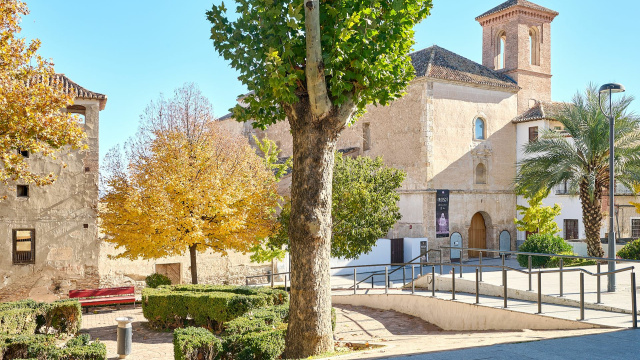
Former Church and Monastery of San Jerónimo (16th-17th c.) and exhibition space
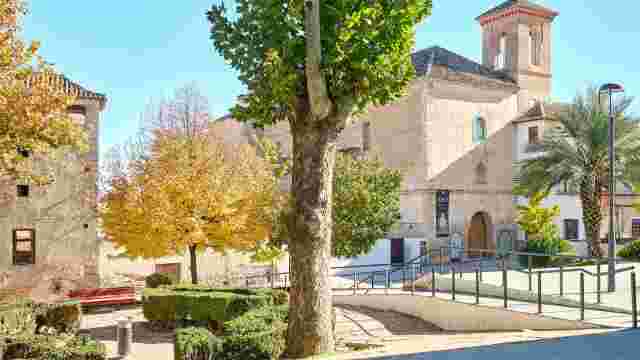
This monastery was founded in 1502 by the Enríquez family. Built as a spiritual annex to their palace and as a luxurious family pantheon, the monastery in Baza was the only Hieronymite monastery, apart from the one in the capital, established in the entire former kingdom of Granada.
The church has a single nave with a transept indicated in the floor plan, with chapels on its north side. The main chapel of the church, made of stone, was built in 1535 in the late Gothic style and was dedicated to the Enríquez-Luna family mausoleum. The chancel is octagonal in shape with buttresses on the outside. This first section is covered with star-shaped ribbed vaults. The central nave is covered by a barrel vault with lunettes supported by transverse arches on a continuous entablature.
It has a choir at the foot. The sacristy was built in 1588. The church was completed in 1690 with the construction of the stone doorway and the enclosure of the side walls in masonry.
During the War of Independence, it suffered the same fate as other convents in Baza, being abandoned by its inhabitants and used as barracks and stables for French troops.
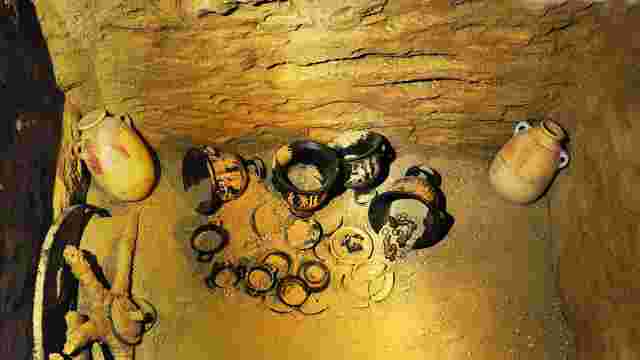
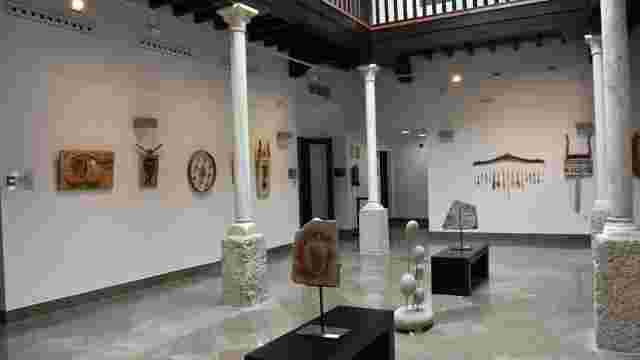
The Iberian Culture Interpretation Centre (CICI) is located in the church of San Jerónimo, a building of great heritage value. The exhibition, which occupies some 400 m2, shows us different aspects of Iberian culture in a broad sense of their daily life, with scale reproductions of everyday scenes and faithful reproductions of some of the main Iberian landmarks, including the tomb of the Lady of Baza itself. All of this helps to contextualise and understand this culture in which ancient Basti played a fundamental role.
It houses the permanent exhibition ‘Iberians. Our civilisation before Rome’, which has been ceded free of charge to the Baza Town Council by the La Caixa Foundation and donated by the Jaén Town Council. Alongside this is the exhibition ‘50 views of a Lady’.